
Marquette County Court Records After Arrest
The arrest-to-court path in Marquette County runs through several offices. The Sheriff's Office and jail handle booking, custody, bond-payment routing, and local jail records. Law-enforcement reports then go to the Marquette County District Attorney, who decides whether to file a criminal complaint and what charges should be alleged. Once a case is filed, the record is tracked through Marquette County Circuit Court and Wisconsin Circuit Court Access.
A jail booking charge can be different from the court charge. A person may be booked on a warrant, an arrest offense, or a hold, but the prosecutor may file fewer counts, add counts, amend the severity, or decline charges. For custody and booking detail, use Marquette County jail inmate records. For booking photos, use Marquette County jail mugshots. For filed charges, hearings, dispositions, and court dates, use court records after the jail arrest.
The screenshot from the official District Attorney page fits this pathway because the DA is the local charging authority for state criminal cases arising from Marquette County arrests.
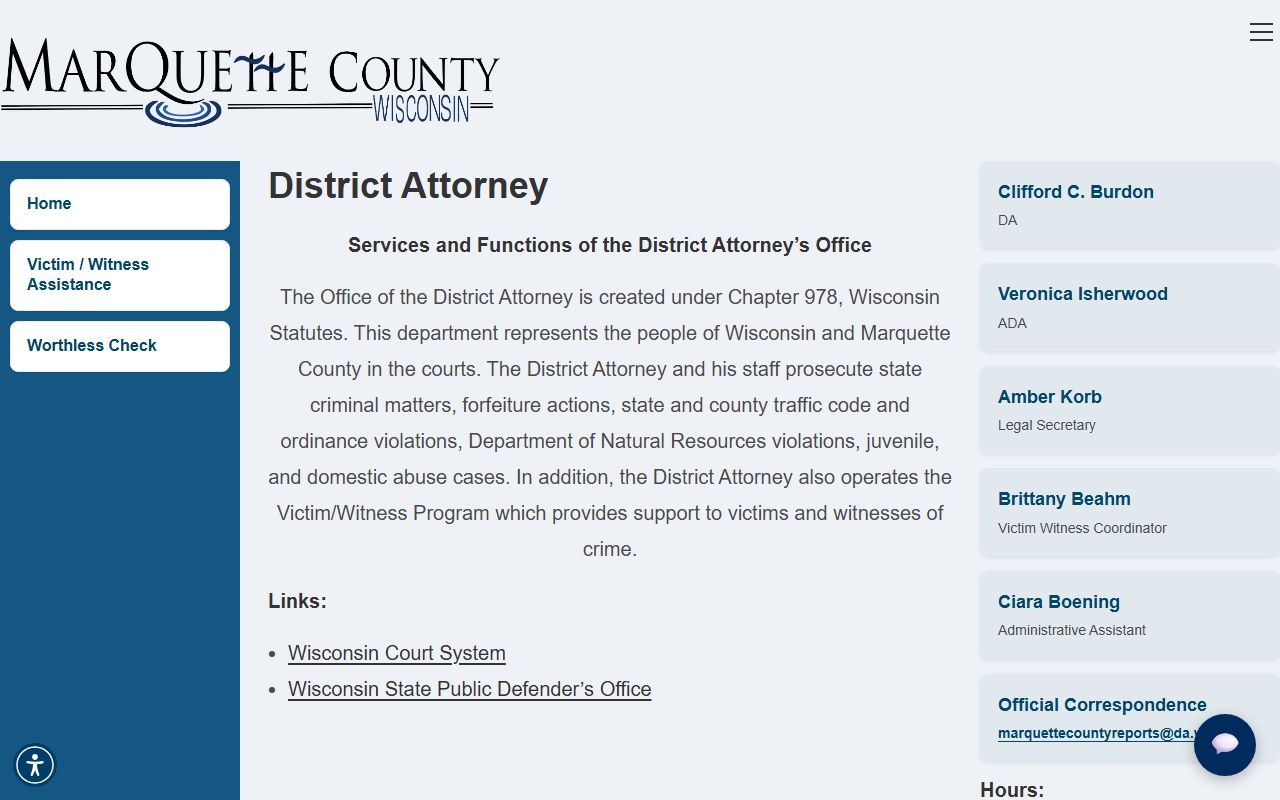
The prosecutor page does not confirm custody. It helps explain who controls the charging decision after the booking record is created.
Find Court Records After Arrest
Wisconsin Circuit Court Access, or WCCA, is the main public portal for Marquette County criminal cases after filing. It is statewide, so county filtering matters. If the arrest was recent, the case may not appear right away. Start with the jail when immediate custody is the issue, then check WCCA case search once the prosecutor has filed the case.
- Confirm recent custody with the Marquette County Jail if the arrest just happened.
- Open WCCA and search by defendant name, case number, or county-filtered criminal case fields.
- Choose Marquette County when possible to reduce same-name matches from other Wisconsin counties.
- Open the case and review charges, statute numbers, severity, filing date, bond events, and next court date.
- Contact the Marquette County Clerk of Circuit Court for certified copies, older files, or in-person record questions.
WCCA is a court-record source, not a jail roster. It may show that a warrant was ordered, a bond was set, or a case was dismissed, but it does not prove that someone is still inside the Marquette County Jail at the moment of search.
Marquette County WCCA Fields
The WCCA search-field table is the most reliable online search feature for court records after a jail arrest in Marquette County. Exact names and case numbers work best. A date-filed range can help when the user knows the arrest date but the case number has not been shared by the jail, attorney, or clerk.
| Field Label | Type | Required | Options / Format Notes |
|---|---|---|---|
| County | Dropdown | Optional but recommended | Choose Marquette to narrow local cases. |
| Case Number | Text | Optional | Exact case number is the cleanest search. |
| Last Name | Text | Commonly used | Defendant surname. |
| First Name | Text | Optional but helpful | Narrows same-name results. |
| Middle Name | Text | Optional | Useful when many results appear. |
| Date of Birth | Date / text | Optional or limited | May be restricted or used for narrowing depending on portal view. |
| Case Type | Dropdown / filter | Optional | Criminal, traffic, forfeiture, civil, family, and other case types. |
| Date Filed range | Date fields | Optional | Helpful when the arrest date is known. |
| Citation Number | Text | Optional | Often tied to traffic or forfeiture matters. |
| Search | Button | n/a | Runs the query. |
| Reset / Clear | Button | n/a | Clears form fields. |
The WCCA portal screenshot in the manifest matches this section because it shows the public case-search interface used for Marquette County court records after a jail arrest.
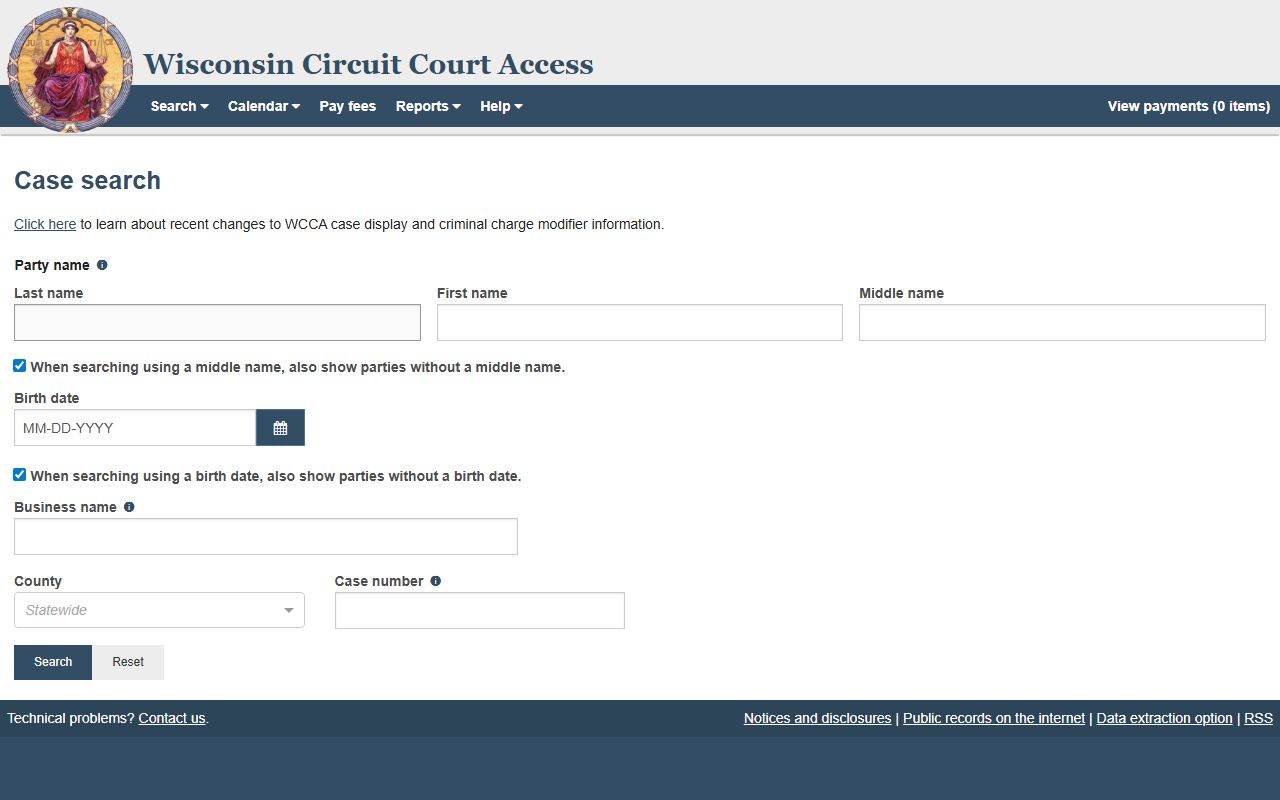
Once a case is open, review each charge line separately because one case can contain multiple counts with different statuses.
Marquette County Charging Documents
Charging documents are the bridge between the jail arrest and the court case. In Wisconsin county prosecutions, the criminal complaint is the common starting document. An information may follow in some felony procedure after a preliminary hearing or waiver. An indictment is a grand-jury charging document and is less common for routine county criminal cases.
| Document | Who Files It | Common Use | Why It Matters |
|---|---|---|---|
| Criminal complaint | District Attorney | Common Wisconsin charging document | Starts the filed court case and states alleged facts and counts. |
| Information | District Attorney | Some felony procedure after preliminary hearing or waiver | Formalizes charges for later felony stages. |
| Indictment | Grand jury process | Less common in routine county matters | Charges by grand jury rather than ordinary complaint filing. |
The charge named at booking is not always the same as the charge named in the complaint. The court record controls the filed case, while the sheriff record explains the jail intake and custody side.
Marquette County Charge Status
Court records after a jail arrest should be read count by count. A single case can contain one pending count, one dismissed count, and one amended count. A charge is an accusation until resolved by dismissal, plea, trial, diversion, or another court action. The status can change more than once during the case.
| Status | What It Means | Search Caution |
|---|---|---|
| Pending | The charge remains active. | Check next court event and bond conditions. |
| Amended or reduced | The prosecutor or court changed the charge or severity. | Compare the original count with the current count. |
| Dismissed | The count ended without conviction on that charge. | Other counts in the same case may still remain. |
| Convicted | Guilt was established by plea or trial. | Review sentence, fines, supervision, and DOC status if applicable. |
| Acquitted | The defendant was found not guilty after trial. | Do not treat the arrest or charge as a conviction. |
| Deferred or diversion | A special outcome may delay or avoid conviction if terms are met. | Check court events and disposition details. |
WCCA case events can include initial appearance, bail or bond hearing, preliminary hearing, arraignment, plea, trial, sentencing, financial orders, and disposition. For certified copies, the local clerk is the proper office.
Bond Warrants and Holds
Bond is part of the court record after many arrests, but release can still depend on jail and agency holds. Wisconsin commonly uses signature bonds, cash bonds, and court-ordered conditions. A signature bond is a promise to appear and follow conditions, sometimes with a dollar amount owed if violated. A cash bond requires money before release. A no-bond hold means the jail cannot release until a court or holding agency acts.
No official Marquette County active-warrant public search page was located. Warrant questions should be handled through the Sheriff's Office, the Clerk of Circuit Court, WCCA, or an attorney. WCCA may show a failure-to-appear event, warrant ordered, bond forfeiture, or warrant return, but the current jail hold should still be verified with the jail. A DOC supervision hold, another county warrant, federal detainer, or ICE detainer can block release even when the local cash bond appears payable.
| Bond or Hold Type | Practical Meaning |
|---|---|
| Signature bond | Release based on a signed promise and conditions. |
| Cash bond | Money must be posted before release, unless another hold blocks release. |
| Probation or parole hold | Wisconsin DOC supervision issue may keep the person in custody. |
| Warrant hold | Another case, county, or court may require appearance or transport. |
| Federal or ICE detainer | Federal or immigration authority may affect release or transfer. |
Charges Versus Convictions
A Marquette County arrest can create public records before any conviction exists. That distinction is central to reading court records after a jail arrest. An arrest is a law-enforcement event. A charge is the prosecutor's formal accusation in court. A conviction occurs only after a guilty plea, a finding of guilt, or a trial verdict. Dismissed, amended, acquitted, or diverted charges should not be described as convictions.
| Point of Comparison | Charge | Conviction |
|---|---|---|
| Stage | Accusation filed in court | Outcome after plea, finding, or verdict |
| Proof level | Based on legal sufficiency to proceed | Guilt established under criminal proof standards |
| Can change | May be amended, reduced, or dismissed | May later be appealed, vacated, or expunged only through legal process |
| How to read it | Check current status and events | Check judgment, sentence, and disposition |
For employment, tenant screening, credit, insurance, or other regulated decisions, casual public-record lookups are not a substitute for a lawful FCRA-compliant background-check process.
Sealed and Expunged Records
Wisconsin public-records law gives access to many court and law-enforcement records, but access has limits. Juvenile records, sealed matters, expunged convictions, victim information, active-investigation material, and security-sensitive jail details may be withheld or redacted. Expunction is not automatic for every dismissed case or old arrest. It depends on statute, eligibility, and a court order.
| Point of Comparison | Sealed | Expunged |
|---|---|---|
| Basic effect | Public access is restricted by court rule or order. | Eligible conviction record is cleared under court order. |
| Wisconsin anchor | Often tied to confidentiality, juvenile status, or case-specific restriction. | Wisconsin Stat. 973.015 governs certain expunctions. |
| Who can answer | Clerk of Circuit Court or attorney. | Court record, sentencing order, and attorney review. |
| Effect on jail records | May not erase every agency record. | Does not make third-party copies reliable or official. |
For an arrest that ended without charges, or for a case that was dismissed, check the WCCA case status and the clerk's records before making claims about the result. For seized property after a case, Wisconsin Stat. 968.20 may be relevant, but it is separate from expunction.
Marquette County Record Roles
Each office answers a different part of the arrest-to-court question. The sheriff is the source for jail custody, booking records, bond-payment routing, and arrest reports subject to open-records limits; the county fee schedule gives local records-fee context. The District Attorney is the charging authority, not the usual public counter for certified case copies. The Clerk of Circuit Court and WCCA handle filed case records, court dates, dispositions, and certified copy questions.
- Sheriff and Jail
- Custody, booking, release status, jail records, and current local holds.
- District Attorney
- Charging decisions, complaints, amendments, prosecution, and victim or witness information.
- Clerk of Circuit Court
- Filed court records, case copies, in-person access, older records, and certified copies.
- WCCA
- Public online case-search portal for Wisconsin circuit court records.
The Clerk of Circuit Court page is the local fallback when WCCA is incomplete, a certified record is needed, or an older file requires office help. The county page lists the clerk at 77 West Park Street, Room 200, Montello, WI 53949, with phone 608-297-3005.
The manifest screenshot for the clerk page is relevant because it points users from online WCCA searching to the county office that maintains court-file access.
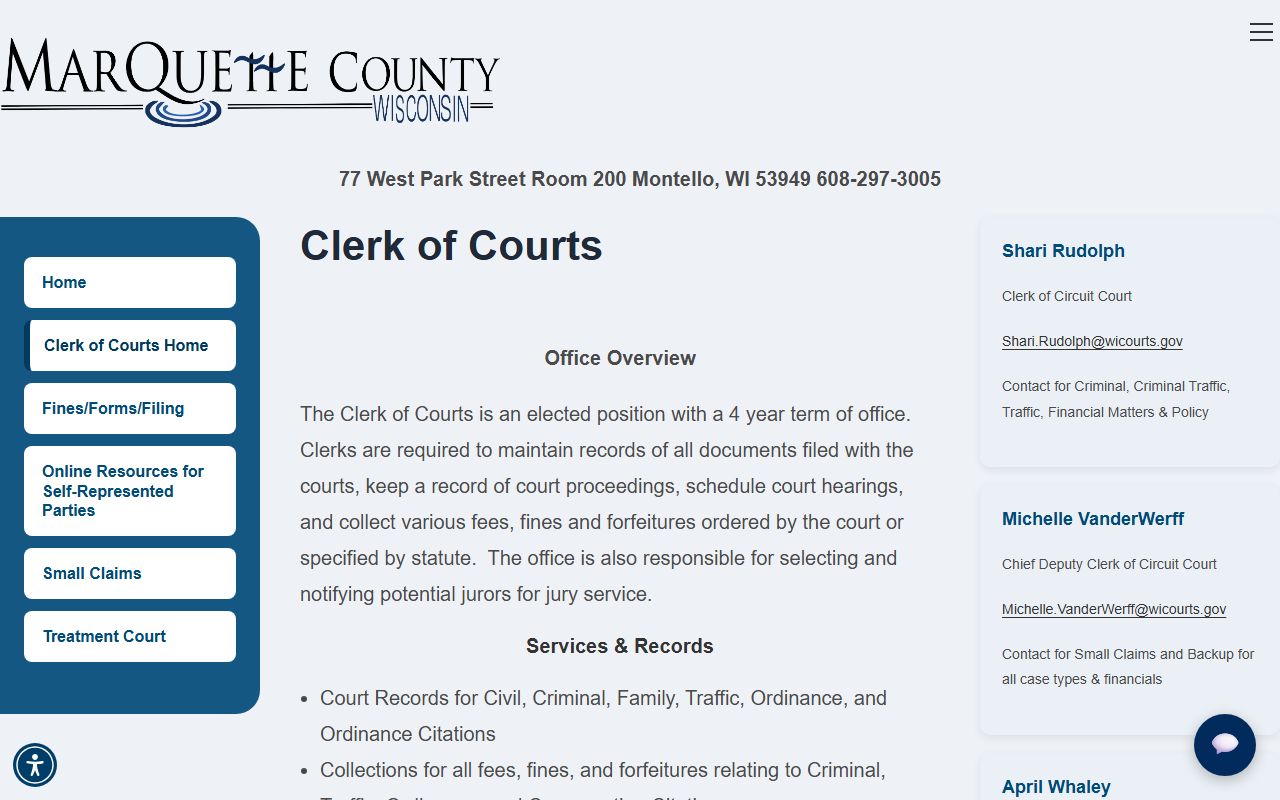
Use the clerk for court-file questions, but use the jail for current custody and release timing.
Public Access Limits
Wisconsin's open-records framework includes Wisconsin Stat. 19.35 for access and Wisconsin Stat. 19.36 for limits and exceptions. Those statutes do not make every jail or court detail public in every case. They let a person request records while allowing redactions or withholding where a law, privacy interest, active investigation, juvenile rule, sealed order, or security concern applies.
State criminal-history checks through Wisconsin DOJ Crime Information Bureau are separate from WCCA and may involve fees. Court records after a jail arrest show what was filed and how the case moved. A criminal-history response is a different record product. Treat both as distinct from commercial people-search summaries.
Important: Do not use public court or jail lookups for FCRA-covered employment, tenant, credit, or insurance screening decisions.